
Reviewed · BUCHAREST COMMUNISM TOURS
Bucharest Under Communism: Life, Terror & Hope
Bucharest’s grand avenues and vast Palace of the Parliament tell two sides of the communist story: a dictator’s monumental plans and the shortages ordinary people endured to help pay for them. This 3.5-hour walk links the architecture to daily life and the protests that brought the regime down.
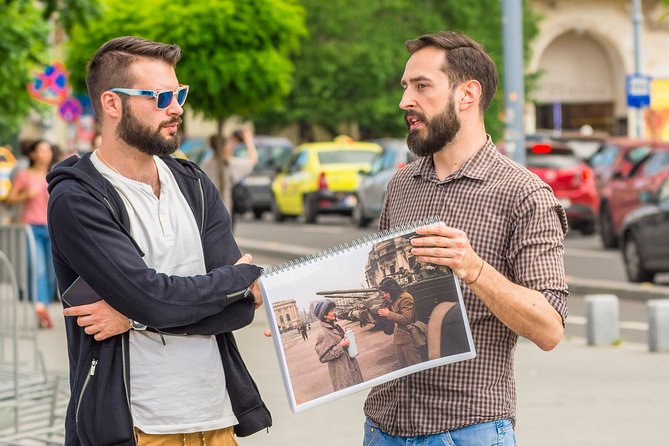
I like that the route pairs big political landmarks with the surviving Mihai Voda Monastery, a quieter stop that makes the city’s losses tangible. I also like the guides’ use of historical photos and personal stories, mentioned by people who took the walk with Laura and Tamar.
One consideration: this is a long, serious walk, and the Palace of the Parliament is viewed from outside, with admission not included. The route details also name University Square as a stop but give Revolution Square as the end point, so it is worth confirming the final route with your guide.
What to know before you go
- Unirii Square puts Ceaușescu’s scale on display: See the fountains and the broad former Victory of Socialism Boulevard.
- The Palace stop is an exterior visit: Hear how the vast building was made, and how its construction coincided with shortages in the 1980s.
- Mihai Voda Monastery survived demolition: Its story offers a striking counterpoint to the utilitarian blocks that conceal some churches.
- Revolution Square connects place and protest: The route covers Ceaușescu’s last speech, demonstrations, the memorial, and the Revolution’s aftermath.
- Guides Laura and Tamar have led the walk: Their explanations, historical visuals, and openness to questions are recurring strengths.
- Plan on about three and a half hours: The tour starts at 4 p.m., costs $23.22 per person, and is capped at 15 people.
A walking route through the communist city
This tour is more than a checklist of imposing buildings. It follows the marks that communist rule left on Bucharest, from the vast scale of its late-era construction to the churches that survived and the squares where citizens challenged the regime. You get a useful frame for the city: what was built, what was removed, and what changed in 1989.
The focus is Romania’s 45 years of communist rule, including dictator Nicolae Ceaușescu, everyday life under the regime, the Romanian Revolution, and the shift from socialism to democracy. The stops make those subjects easier to grasp. Instead of treating communism as a distant political chapter, your guide connects it to streets, buildings, and public spaces you can see.
The experience is listed as a private walking tour, with a maximum of 15 people. That cap should make it easier to hear the guide and ask questions than on a much larger group walk. The guides named in accounts of the tour include Laura and Tamar. They have been praised for clear explanations, historical photos, personal stories, and answering questions; your assigned guide may differ.
More communism tours around Bucharest:
- Bucharest: Palace of Parliament Tickets and Guide
★ 4.3 · 3,182 reviews - Bucharest: Palace of Parliament Tickets and Guided Tour
★ 4.4 · 1,877 reviews - Bucharest: Parliament Palace Skip-the-line Ticket
★ 4.2 · 1,518 reviews
Unirii Square and the boulevard of ambition
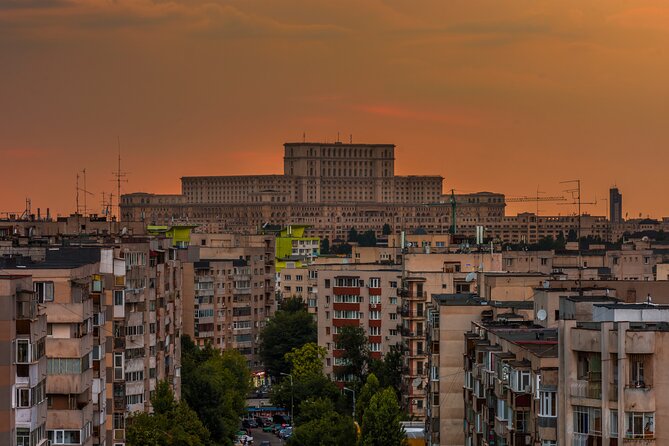
The walk begins at Piața Sfântul Anton 64, then heads to Unirii Square, a central space shaped during communism’s final phase in Romania. Its fountains give the square a grand, staged feel, but the bigger story is the avenue running through it: the former Victory of Socialism Boulevard.
From here, you can see how a city can be redesigned to express power. The scale of the boulevard reflects Ceaușescu’s ambition for Bucharest, and walking along it gives you a sense of how that vision altered the capital. Your guide can explain the thinking behind the project and place it in the final years of communist rule.
I like this opening because it gives you a visual key for the rest of the tour. Later, when you stand before the Palace of the Parliament, its size will feel less like an isolated architectural oddity and more like part of a larger plan for the city.
The Palace of the Parliament, seen from outside
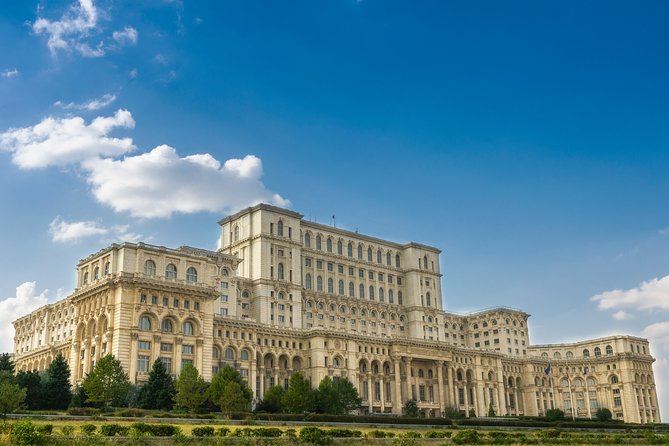
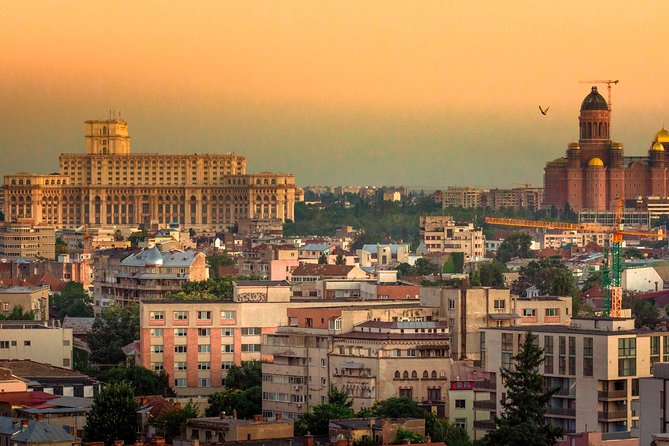
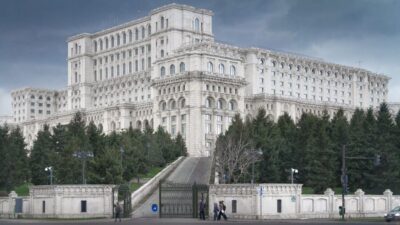
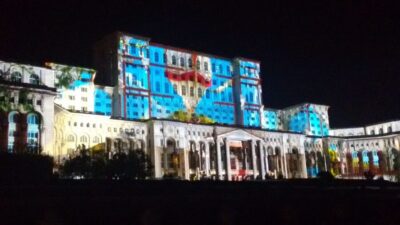
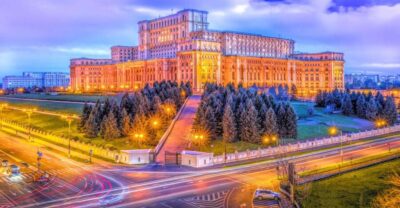
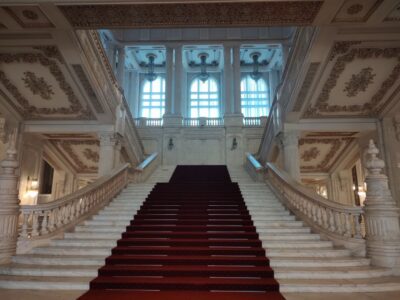
The Palace of the Parliament is the route’s largest and most dramatic landmark. It is described as the world’s second-largest building after the Pentagon and the most expensive administrative building. The stop lasts about an hour, with views from different angles and an explanation of how the structure was built.
The human cost is central to the story. The building required huge amounts of money, material, and labor, while Romanians faced shortages of basic goods during the 1980s. That contrast is what makes the Palace more than a feat of scale: it embodies the distance between the regime’s public image and people’s daily experience.
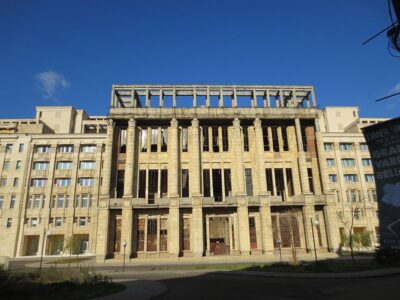
Across from the Palace, you will also see the Academia Romana building, a large construction in a similar style. It was intended for Elena Ceausescu, the dictator’s wife. This detail adds another layer to the tour’s account of power and personal privilege.
There is an important practical distinction: the tour views the Palace from outside, and admission is not included. If you want to go inside, this walk does not promise that visit. Its value here is the guide’s context and the chance to take in the building’s scale from the surrounding streets.
Mihai Voda Monastery and the churches that survived
After the monumental architecture, Mihai Voda Monastery offers a different kind of history. This medieval church survived the period of demolition that removed other religious buildings. The tour explains how some churches were destroyed and how others were saved, including the curious sight of churches hidden behind utilitarian buildings.
That contrast is one of the walk’s most useful stops. Communist-era redevelopment did not simply add new buildings; it also changed what could be seen and remembered in the city. A surviving religious site can help you picture a Bucharest that predates the regime’s large-scale rebuilding.
The stop is listed at about 30 minutes and has no admission charge. It also gives the tour a pause from grand façades and political spectacle. If you are interested in architecture or religion, listen for how your guide connects the monastery’s survival to the broader changes imposed on Bucharest.
More Bucharest tours around Bucharest:
- Bucharest: Dracula’s Castle, Peles Castle, & Brasov Old Town
★ 4.5 · 17,858 reviews - Bucharest: Dracula Castle, Peles Castle & Brasov Old Town
★ 4.6 · 10,891 reviews - Bucharest: Dracula’s Castle, Peleș Castle & Brașov Day Trip
★ 4.5 · 5,919 reviews - Bucharest: Day Trip to Dracula Castle, Peles Castle & Brașov
★ 4.4 · 3,049 reviews
Revolution Square, from the dictator’s balcony to the protests
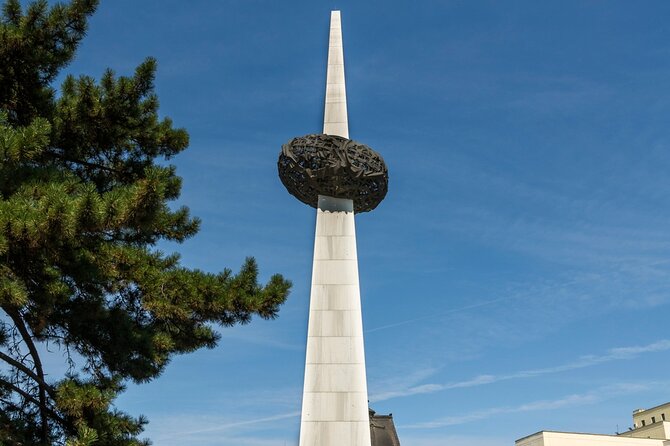
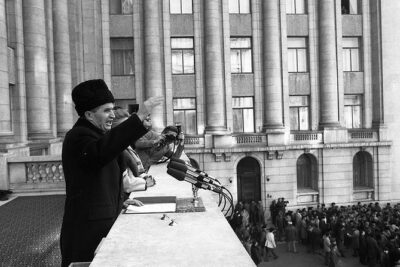
Revolution Square brings the story to its breaking point. Here you see the building that housed Ceaușescu’s office and the balcony where he made his last speech. The square was also the site of the first mass demonstration in Bucharest, making it a place where the end of the regime can be tied to a specific setting.
The guide covers what happened to people who protested against totalitarian rule, the memorial dedicated to them, and the aftermath of the Revolution. This is likely to be one of the more sobering parts of the walk. The subject is not only the fall of a dictator, but also the danger faced by people who took to the streets.
The stop is scheduled for about an hour, which gives the guide room to explain several connected events rather than rush past the landmarks. If you have questions about how Romania moved from socialism to democracy, this is a good point to ask them. Guides on this route have been described as willing to take questions and add detail beyond the basic story.
The tour’s stated end point is Revolution Square, about five minutes from the Old Town. The stop list also includes University Square after Revolution Square, so the route information is not fully consistent about the final stop. Ask your guide at the start where the walk will finish that day.
University Square and the cost of protest
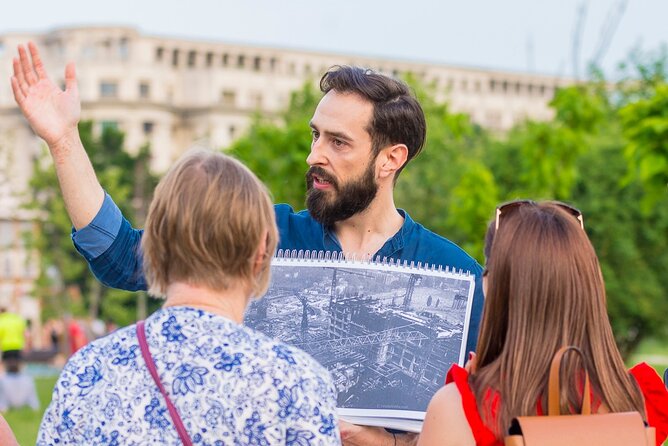
University Square is listed as a further stop and is described as a focal point for the main protests against communism in 1989. The account of the tour notes that hundreds were killed for their belief in a free society. That makes this more than a final photo stop; it brings the human stakes of the Revolution into sharp focus.
Because the tour information places this stop after Revolution Square but identifies Revolution Square as the end point, the exact sequence or endpoint may vary. The practical answer is simple: check with your guide before setting your plans for after the walk.
The listed stop lasts about 30 minutes. If included in your route, it completes the movement from Ceaușescu’s public authority to the demonstrations that challenged it. Together with Revolution Square, it gives the tour a strong focus on civic courage and the cost of political change.
How much the tour is worth
At $23.22 per person for around three and a half hours, this is a relatively modestly priced way to get historical context at several major sites. The fee buys a guided walking experience, not entry to the Palace of the Parliament. For the value calculation, consider how much more meaningful the boulevard, Palace, monastery, and protest sites become when someone explains what happened there.
The private-tour description suggests a more personal format, while the group cap is 15. That is small enough for questions to be practical, but it is not a guarantee that you will be alone with the guide. The strongest reported element is the guide’s teaching: Laura and Tamar have been singled out for clear history, engaging delivery, photos, and answering questions. Those qualities matter on a route where the buildings alone cannot explain the full story.
The tour also helps you put Bucharest’s visible contrasts in context. You move between imposing communist projects, an old monastery, and squares tied to protest. If you are spending only a short time in the city, that combination can give you a solid starting point for exploring further.
Timing, meeting point, and what to plan for
The walk starts at 4 p.m. at Piața Sfântul Anton 64 in Bucharest. It ends in the Revolution Square area according to the meeting details, close to the Old Town, though University Square is also included in the stop list. Confirm the day’s route and finish point when you meet your guide.
Allow about three and a half hours. The scheduled stops total roughly three and a half hours: 30 minutes at Unirii Square, an hour at the Palace, 30 minutes at Mihai Voda Monastery, an hour at Revolution Square, and 30 minutes at University Square. Since the route is on foot, wear shoes you are comfortable walking in. The tour is described as suitable for most people and allows service animals.
You receive confirmation when booking, and the ticket is mobile. Free cancellation is available up to 24 hours before the start time. If poor weather cancels the tour, you are offered another date or a full refund.
Who will get the most from this walk
I would put this tour high on the list if you want to understand how communism shaped Bucharest rather than simply photograph its most famous buildings. It is especially useful for a first visit, when you need a basic timeline and a guide to the city’s political landmarks. The accounts of Laura and Tamar suggest that the walk can also suit visitors who enjoy questions, photos, and anecdotes alongside formal history.
It is a good fit if you are interested in twentieth-century Europe, architecture, religion, or the Romanian Revolution. The route combines all four without requiring separate visits to each location. Romanian visitors may also find details and stories that add another perspective on familiar places.
Think twice if you want an indoor visit to the Palace, a light sightseeing stroll, or a route with little walking. The subject includes repression, deaths, and shortages, and the listed duration is substantial. This is a history-focused walk, not a general city tour with a little communist-era background on the side.
Should you book it?
Book this walk if you want a clear, place-based introduction to Romania’s communist years and the events of 1989. Its best feature is the combination of landmark architecture and human stories, especially at Unirii Square, the Palace, Mihai Voda Monastery, and the protest sites.
Skip it if you mainly want to tour the Palace’s interior or prefer a shorter, less serious outing. At $23.22, the value is strongest for someone who wants a guide to connect the sights and explain what the buildings mean. Before setting your afternoon plans, confirm whether University Square is part of your route and where the group will finish.
FAQ
How long is the tour?
It lasts approximately three hours and 30 minutes.
What time does the tour start?
The stated start time is 4 p.m.
Where does the tour begin?
It begins at Piața Sfântul Anton 64, București 030167, Romania.
Where does the tour end?
The meeting information gives Revolution Square as the endpoint, about five minutes from the Old Town. The stop list also includes University Square, so confirm the exact finish with your guide.
How much does the tour cost?
The listed price is $23.22 per person.
Is admission to the Palace of the Parliament included?
No. Admission to the Palace is not included; the tour describes an exterior visit and views from different angles.
Which landmarks are included?
The listed stops are Unirii Square, the Palace of the Parliament, Mihai Voda Monastery, Revolution Square, and University Square.
Is this a private tour?
It is described as a private walking tour, with a maximum of 15 travelers.
Can I bring a service animal?
Yes. Service animals are allowed.
What happens if bad weather cancels the tour?
You will be offered a different date or a full refund.
Recently added around Bucharest
- Snowmobiles, Sky Lift & Winter Sports – Private Tour★ 5.0 · 9 reviews
- Private Transfer and 3H Tickets to Therme Bucharest★ 4.5 · 10 reviews
- Day Trip from Bucharest to Dracula Castle, Brasov and Peles Castle Sinaia★ 5.0 · 10 reviews
- Day Trip Through Brasov in Transylvania and Bran, Peles, and Rasnov Castles★ 4.0 · 9 reviews
- 2-Day Small-Group Tour to Dracula’s Castle, Rasnov Fortress, Peles Castle, Sighisoara and Libearty Brown Bear Sanctuary with Overnight in Brasov★ 4.5 · 9 reviews
- Slavery in Romania Myths and Truths About Gypsies★ 5.0 · 8 reviews
- The Real Story of Gypsies – Slavery in Romania★ 5.0 · 7 reviews
- Premium 8-Day Private Culinary Vacation in Romania★ 5.0 · 11 reviews
Bucharest Communism Tours, compared.
Parliament Senate Entry Tickets and Guided Tour
Read our review →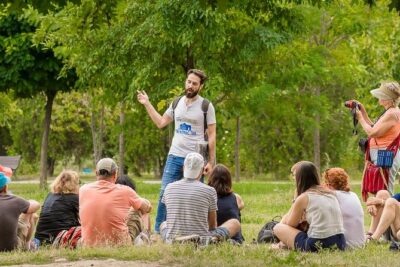
Bucharest Essential Tour: Old Town, Calea Victoriei & Communism
Read our review →Browse the lists this tour appears in