Reviewed · BUCHAREST TOURS
5h Bucharest City Tour by Car/Minivan – Small Group max 7 people
Bucharest can be hard to read at street level: grand avenues, communist-era monuments, old churches and new construction sit side by side. This five-hour drive with stops gives you a useful first map of the city, from the Palace of the Parliament to a wetland reserve formed on the site of an unfinished communist project.
I like two things in particular: the small group, capped at seven, gives you more room to ask questions, and hotel pickup saves you the trouble of finding a meeting point before a busy day of sightseeing. The route also makes room for places that are easy to miss if you stick to the central squares, including Ferentari and Văcărești Natural Park.
One consideration: this is a wide-ranging introduction, not a deep visit to every landmark. Most stops last about 15 minutes, and admission to the Village Museum and Romanian Athenaeum costs extra. If you want a leisurely museum day, plan to return to your favorites afterward.
What to know before you go
- A broad route in five hours: The tour links central Bucharest with southern and northern sights, so you can get your bearings without making every trip on foot.
- A small shared group: The van holds no more than seven travelers, which gives the guide more chance to answer questions and adjust the day.
- Two paid attractions: Village Museum entry is 40 RON, about €8. Athenaeum entry is 15 RON, about €3, and must be paid in cash.
- A full hour at the Village Museum: This is the longest scheduled stop and the best chance to explore a site rather than just take a photo.
- A guide can adapt the day: Sebastian has been praised for clear communication, patience and changing plans when a museum was closed for a holiday.
- A 9:30 a.m. start: Pickup is offered at centrally located hotels, and the tour lasts about five hours.
A city tour that makes sense of contrasts

The route is a brisk sampler of Bucharest’s many sides. In one half-day, you see monuments tied to communist rule, places of national memory, Orthodox landmarks, central squares, and a patch of wildlife habitat inside the city. That range is useful if you have limited time or want context before exploring on your own.
A car or minivan matters here. The stops are spread across Bucharest, and driving between them helps you cover more ground than a walking tour could. You trade some time on foot for a broader view of the city, its scale and the shifts between districts.
The group limit of seven is another practical advantage. A small group is not a private tour, but it can make it easier to hear the guide, ask a follow-up question or express a preference. The guide’s role matters: one named guide, Sebastian, has been praised for being punctual, patient and willing to tailor the route. Your guide may be someone else, but those are useful qualities to expect from a tour built around explanation and short stops.
More Bucharest tours around Bucharest:
- Bucharest: Dracula’s Castle, Peles Castle, & Brasov Old Town
★ 4.5 · 17,858 reviews - Bucharest: Dracula Castle, Peles Castle & Brasov Old Town
★ 4.6 · 10,891 reviews - Bucharest: Dracula’s Castle, Peleș Castle & Brașov Day Trip
★ 4.5 · 5,919 reviews
The Parliament, cathedral and Ferentari
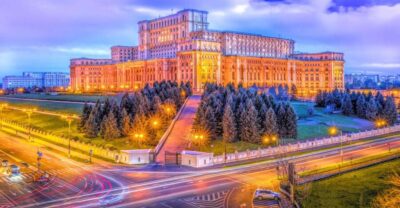
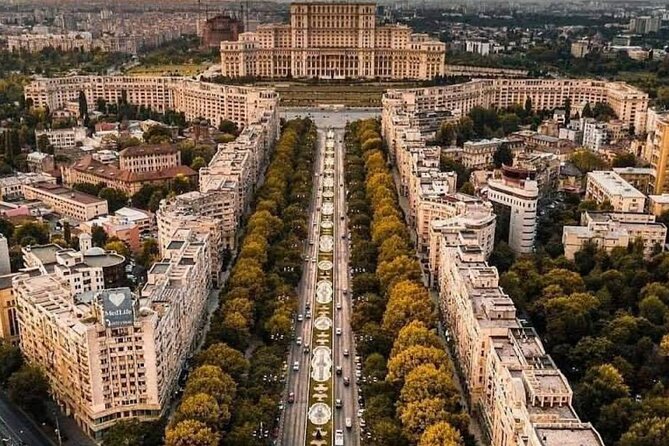
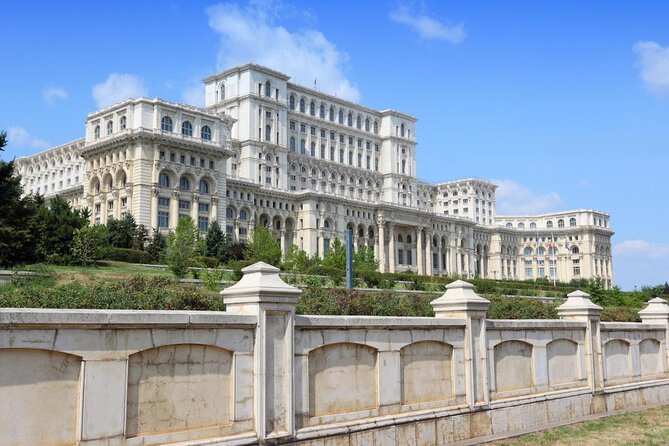
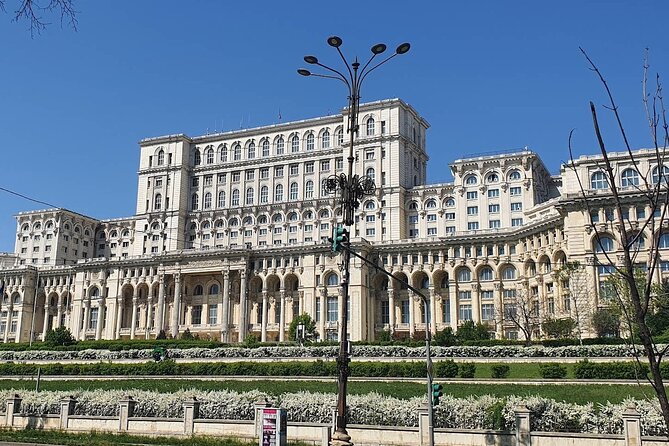
The first stop is the Palace of the Parliament, a building that is difficult to grasp from a photograph. It is described as the heaviest building in the world, weighing about 4.1 million tonnes. You have 15 minutes here, with no admission fee listed, so treat this as an outside visit and a chance to take in its vast scale rather than a full tour of the interior.
Nearby, the People’s Salvation Cathedral offers a striking contrast. Designed to be the world’s largest Orthodox church, it represents religious identity and national pride in a city shaped by decades of communist rule. Construction began in 2010, and the cathedral was consecrated in 2018 while still under development. The stop is also 15 minutes, enough to see the exterior and hear why it matters.
Ferentari brings the route into a more difficult part of the city’s story. The southern neighborhood is associated with poverty, unemployment and gaps in infrastructure and public services, while also being home to a diverse, resilient community. A short visit cannot explain those issues fully, so I would treat this stop as a prompt to listen and learn, not as a chance to regard people’s daily lives as a spectacle. The guide’s framing is especially important here.
Carol Park, Văcărești and a church tied to a legend
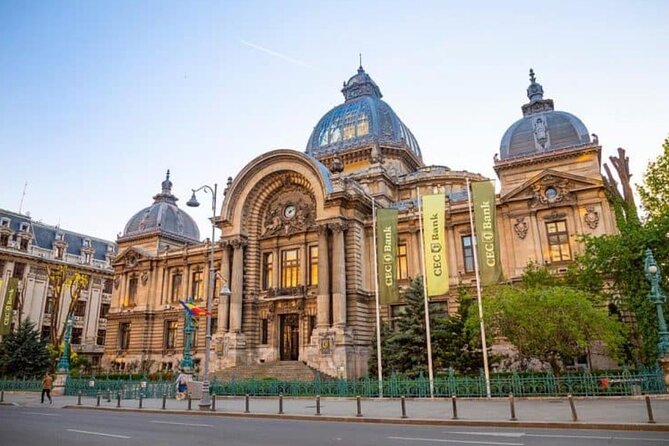
Carol Park’s memorial shows how a monument can change meaning with a country’s politics. Built in 1963 as a mausoleum for Communist leaders, the red-granite structure now serves as the Tomb of the Unknown Soldier, honoring Romanian soldiers who died in battle. You have about 15 minutes to see the memorial and its park setting.
Văcărești Natural Park is a surprising change of scene. Known as the Delta of Bucharest, this roughly 190-hectare reserve formed on the site of an unfinished communist-era reservoir. Its wetlands now support birds, amphibians and rare plants. The scheduled stop is only 15 minutes, so expect an introduction or a brief look, not a long nature walk.
The small Bucur the Shepherd’s Church offers a quieter kind of history. Local legend links its founding to Bucur, the shepherd said to have given Bucharest its name, though the exact origins are uncertain. The church dates to the 18th century and is among the city’s oldest surviving religious buildings. Its modest scale makes a useful counterpoint to the monumental buildings elsewhere on the route.
Two central squares and a former dictator’s home
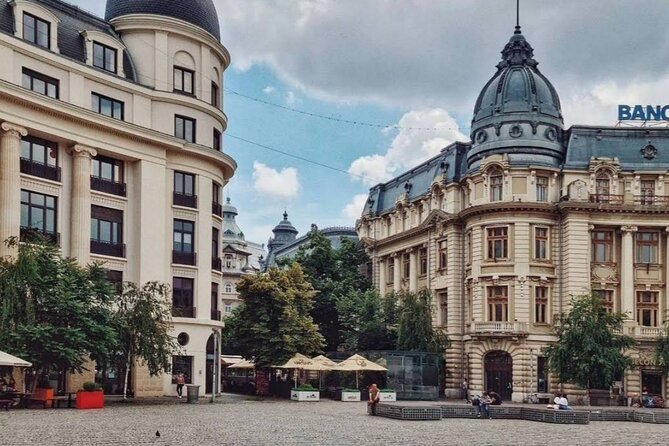
Unirii Square is one of Bucharest’s major public spaces and transport hubs. Its large fountains, shopping centers and broad boulevard show the city’s modern, busy side, while its central position makes it a useful reference point for finding your way around later. The stop is 15 minutes, so expect an overview rather than time to explore the area at length.
University Square has a different kind of weight. Set in front of the University of Bucharest, it is associated with the 1989 Revolution and later public demonstrations. The National Theatre and university buildings help make this a civic and academic center, not just a traffic junction. At 15 minutes, you should have time to take in the setting and hear why the square matters.
Ceaușescu’s Mansion, also called Spring Palace, reveals the private luxury of Romania’s former communist leader and his family. The residence has grand halls, a private cinema and an indoor pool, all a stark contrast to the hardship experienced by many people under his rule. The property opened to the public in 2016. The tour allocates 15 minutes here, so check whether the timing includes an interior visit before counting on a full house tour.
Same starting point, a different day out:
- Bucharest: Palace of Parliament Tickets and Guide
★ 4.3 · 3,182 reviews - Bucharest: Day Trip to Dracula Castle, Peles Castle & Brașov
★ 4.4 · 3,049 reviews - Bucharest to Dracula Castle, Peles Castle and Brasov Guided Tour
★ 4.5 · 2,933 reviews - Bucharest: Palace of Parliament Tickets and Guided Tour
★ 4.4 · 1,877 reviews
The Village Museum, Arch of Triumph and opera
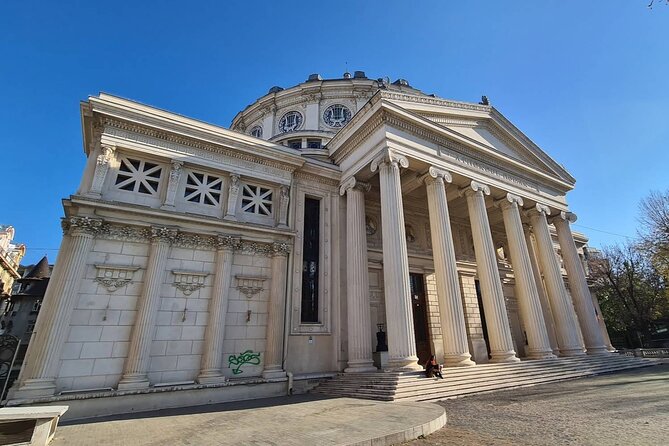
The Village Museum is the longest stop, with one hour set aside. Founded in 1936, this open-air museum gathers more than 200 traditional houses, farms and churches from different parts of Romania. Set beside Herăstrău Lake, it gives you a quick way to compare regional building styles and rural life without leaving the capital.
Admission is not included: budget 40 RON, about €8 per person. An hour gives you more breathing room than the short photo stops, though the site is large enough that you will need to choose what to see. If traditional architecture interests you, use this time to look closely at how the houses and churches differ, rather than trying to cover every corner.
The Arch of Triumph marks a return to national ceremony. First built in 1922 to honor soldiers who fought in World War I, it was rebuilt in granite in 1936. Its 27-meter form was inspired by the Arc de Triomphe in Paris, but its meaning is Romanian: a memorial to sacrifice and a focal point for national celebrations and military parades. The stop lasts 15 minutes.
The National Opera of Bucharest, founded in 1921, brings the route back to cultural life. It hosts opera, ballet and other performances, and its building is a reminder that the city’s identity is not only political or architectural. The scheduled 15-minute stop is a brief look; if a performance interests you, you would need to plan a separate visit.
The Athenaeum, Revolution Square and Calea Victoriei
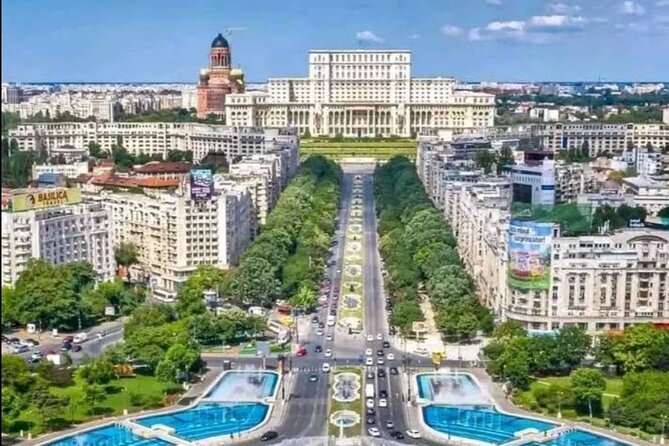
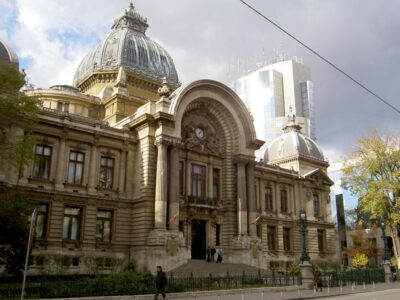
The Romanian Athenaeum is one of Bucharest’s most admired cultural buildings. Opened in 1888, this concert hall is known for its neoclassical design and domed roof, and it is home to the George Enescu Philharmonic Orchestra. The tour allows 30 minutes here, longer than at most stops, giving you more time to appreciate the building.
Entry costs 15 RON, about €3, and is cash only. Since access and opening arrangements can vary, ask your guide what is possible that day. The guide has previously adjusted plans around holiday closures, a useful reminder that a flexible approach can save time when an attraction is not open.
Nearby Revolution Square is central to the story of the 1989 Revolution that ended communist rule. The square is surrounded by significant buildings, including the former Royal Palace, and its memorials honor those who died in the fight for freedom. A 15-minute stop is enough to hear the key context, but not to study every monument.
Calea Victoriei is one of Bucharest’s historic streets, lined with architecture, museums, shops, cafes and theaters. It has served as a cultural and commercial route since the 17th century, and it remains a good place to return to on foot after the tour. The scheduled 15 minutes gives you a glimpse of the street, not time to browse its many stops.
The price, pace and practical details
At $95.12 per person, the main value is the combination of transport, hotel pickup, an English-speaking guide and a route across a broad area. If you tried to reach all these places independently in five hours, you would need to plan several journeys and make careful choices about what to skip. The small-group format adds a more personal feel than a large coach tour.
The price does not cover lunch or the two listed admissions. Budget another 55 RON, about €11, if you plan to enter both the Village Museum and Athenaeum, and bring cash for the Athenaeum fee. If you decide not to visit either interior, you can still see many of the route’s landmarks from the outside, but the museum hour is a central part of the day.
Pickup is offered from centrally located hotels, and the tour starts at 9:30 a.m. Confirm pickup details when booking. The experience is offered in English, uses a shared car or minivan, and has a maximum group size of seven. Most people can participate, and the tour is near public transportation.
A few stops are short by design. With about 15 minutes at many locations, this is best treated as a city orientation rather than a series of full visits. The guide may be able to adjust the plan to account for closures or your interests, but the tour still has a five-hour window and a long list of places to cover.
Is this the right Bucharest tour for you?

I would choose this tour if you have one day to get acquainted with Bucharest, want a guide to connect the city’s monuments with Romanian history, or prefer not to arrange transport between far-flung sights. It is particularly useful early in a stay: you can note which places deserve a longer return visit.
It is less suitable if you want to spend several hours inside museums, walk at a slow pace or focus on one period of history. The short stops and broad route favor range over depth. For a good balance, use the tour to build your mental map, then revisit the Village Museum, Athenaeum or Calea Victoriei on your own.
The strongest reason to book is the mix: a small group, hotel pickup and a route that includes both famous landmarks and less expected places such as Ferentari and Văcărești Natural Park. If that kind of city introduction fits your plans, the price is reasonable for a guided half-day with transport. If you would rather explore fewer places at length, spend the money on a focused visit instead.
FAQ
How long is the tour?
It lasts about five hours.
What time does the tour start?
The start time is 9:30 a.m.
Is hotel pickup included?
Yes. Hotel pickup is offered from centrally located hotels.
How large is the group?
The shared group is limited to a maximum of seven travelers.
What language is the tour offered in?
The tour is offered in English, with a professional English-speaking guide.
Are entrance fees included?
No. Village Museum entry costs 40 RON, about €8, and Athenaeum entry costs 15 RON, about €3, payable in cash.
Is lunch included?
No. Lunch is not included.
Recently added around Bucharest
- Snowmobiles, Sky Lift & Winter Sports – Private Tour★ 5.0 · 9 reviews
- Private Transfer and 3H Tickets to Therme Bucharest★ 4.5 · 10 reviews
- Day Trip from Bucharest to Dracula Castle, Brasov and Peles Castle Sinaia★ 5.0 · 10 reviews
- Day Trip Through Brasov in Transylvania and Bran, Peles, and Rasnov Castles★ 4.0 · 9 reviews
- 2-Day Small-Group Tour to Dracula’s Castle, Rasnov Fortress, Peles Castle, Sighisoara and Libearty Brown Bear Sanctuary with Overnight in Brasov★ 4.5 · 9 reviews
- Slavery in Romania Myths and Truths About Gypsies★ 5.0 · 8 reviews
- The Real Story of Gypsies – Slavery in Romania★ 5.0 · 7 reviews
- Premium 8-Day Private Culinary Vacation in Romania★ 5.0 · 11 reviews
Bucharest Tours, compared.
Dracula’s Castle, Peles Castle, & Brasov Old Town
Read our review →
Dracula’s Castle, Peleș Castle & Brașov Day Trip
Read our review →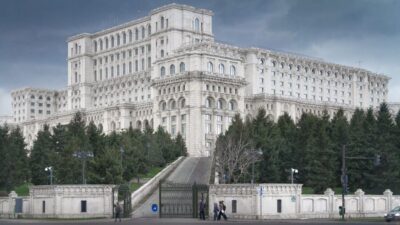
Bucharest to Dracula Castle, Peles Castle and Brasov Guided Tour
Read our review →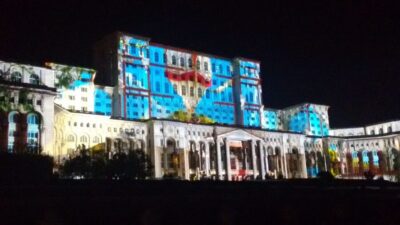
Transylvania and Dracula Castle Full Day Tour from Bucharest
Read our review →